The Atmosphere and Flight
|
|
[Introduction] [The Atmosphere]
|
Unit: Aviation Weather
Topic: Cloud Formation
|
Subject: Science Grade: 3, 4, 5 and 6 |
Duration: Class period |
Learning Experience:
Condensation does not occur only on objects such as grass and cars; it can occur in the air. A decrease in pressure can cool air enough to cause condensation of some of its water vapor. Students in this learning experience will create small clouds in mayonnaise jars by raising and lowering the pressure of the air in the jar by pressing and pulling on a rubber balloon. |
Essential Questions:
What are the common causes that form clouds in the troposphere?
|
Educational Objective:
The student will...
- Demonstrate cloud formation in air by means of a homemade cloud chamber.
Materials:
|
# of Students per Item |
Item |
#of Students per Item | Item |
|
2 | Large glass mayonnaise jar | 2 | Large round balloon |
| 2 | Scissors | 2 | 3 rubber bands large enough to go around the top of the jar |
Teacher Background:
There are cloud creation apparatus for teacher demonstration. (For example, you can obtain one like the chamber below from Frey Scientific.) Students will enjoy making and using their own cloud chamber, though. Know that it may take several tries before a cloud appears in the homemade chamber.
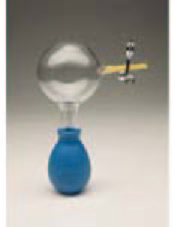
The smoke from the match provides tiny particles, and makes the condensing water droplets a little larger and easier to see, even after the smoke itself has become invisible.
Pull the rubber up beyond the height of the rim of the jar. The idea is to have a sudden, rather large increase in the interior volume after the rubber has been pressed down. Make sure the balloon does not pull out of its rubber band fastenings. The jar must be sealed at all times.
Each time the rubber is pulled up, the air in the jar will go momentarily cloudy. The cloud will disappear when the rubber is pressed down again.
Dimming the room and using a flashlight or a projector beam at right angles to the observer can make the droplets easier to see. The tiny drops condense because the air in the jar cools below its dewpoint when the rubber is pulled up. This is because the air in the jar expands greatly. Since the same mass of air now takes up more space or volume, its pressure is less.
|
Advanced Preparation:
- Read through the entire lesson plan and try out the homemade cloud chamber before you try it with the class.
- Safety: A match is a big part of this experience. Ask students the day before if they feel comfortable lighting a match. If you are doing this with younger children, send a letter home to the parents, and you may want to light all of the matches for the children yourself.
- Keep a cup of water to put the burned matches in after they are lit.
|
Science Vocabulary:
- Pressure—the amount of force acting on each part of a surface, as, for example, the number of pounds acting on one square inch.
|
Procedure:
- To make a homemade cloud chamber, first cut a large, curved, rubber sheet from a large, round balloon.
- Then pour 3cm of room temperature water into the jar.
- Stretch the rubber sheet over the open top of the jar, cover it, and fasten with three rubber bands around the top to hold the balloon securely in place.
- In a few minutes, strike a match. While it burns, ask a classmate to uncover the jar. As they do it, flick out the match.
- While it is still smoking, lower the match into the jar to catch some of the smoke. Then quickly replace the rubber sheet. Fasten it tightly once more.
- Wait one minute, press down on the rubber cover. Hold it down for about five seconds. Then pull up on the cover fast and hard.
- Repeat the pressing down and pulling up several times.
- Now darken the room and shine a beam of light through the jar from one side. The light will reflect from the droplets of water, no matter how small they are.
|
Questions:
- What happens inside the jar when you pull up?
- Does it happen each time you repeat the pressing down and pulling up?
- What causes the tiny droplets to condense?
- What caused them to evaporate just as quickly?
|