 |
 |
 |
 |
 |
 |
 |
 |
 |
 |
 |
 |
 |
|


It's All About Air Pressure Part 2 - Bernoulli's Principle |
||
| Bernoulli's Principle is key to understanding many physical phenomena, including why a curve ball curves and how an airplane wing develops the lift to get a huge aircraft off of the ground. Below is a simple description of Bernoulli's Principle and an activity using NASA's FoilSim that will illustrate how air pressure can be used to provide this lift to an aircraft wing. |
||
|
Bernoulli's Principle Bernoulli's principle is basically a statement of the law of conservation of energy written for the movement of a fluid such as air. For some important real life examples, the two main terms of this equation turn out to be the kinetic energy and pressure of the moving gas. This very simplified equation would then look like this:
The left side is for the gas at point 1 and the right side for the gas at point 2. So, if a gas is placed in a situation where its velocity is decreased, its pressure must increase. This is assuming that no energy is added to or subtracted from the gas between point 1 and point 2. |

|
Links
|
|
|
A description of one of the many forms of Bernoulli's equation.
|
|
|
This is a QuickTime movie of several examples of this demonstration of Bernoulli's Principle.
|
|
|
Illustrates how if KE goes up, the pressure must go down.
|
|
|
A demonstration of Bernoulli's Principle where you blow between two empty soda cans.
|
|
|
Another java applet that illustrates how Bernoulli's Principle explains why and how a curve ball will move.
|
|
NASA's FoilSim NASA's FoilSim is a simulation of the air moving across an airplane wing. A screen shot of the simulation is shown below. The air is shown by the white and blue lines in the upper left hand corner. The wing is shown in white. The simulation allows you to see graphs (Plots), take data from around the wing (Probe), and measure the lift that the wind generates (Lift Meter). The Plots and Probe allow you to measure the pressure and velocity of the air around the wing. There are many other variables that can be changed, including the speed and altitude of the plane. Also note that the temperature, air pressure, and density of the air are given. 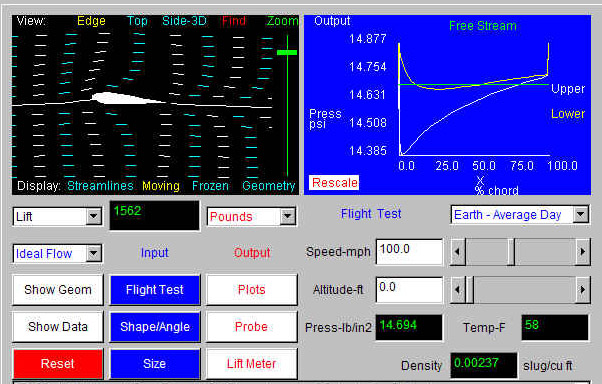
To run the FoilSim
simulator, go to the following website: The following activity will illustrate how the air pressure and velocity changes above and below the wing to produce lift. Only a few of the variables will be investigated, but you can play around with the others on your own. Follow the step by step procedure, filling in the answer as you go. You can either print out this page and fill in the answers, or fill in the answers and then print out the page. |
|
|
FoilSim Activity - Air pressure and velocity around an airplane wing. Part 1 - Plots |
| |
| Part 2 - Probe | |||||||||||||||||||||||||||
|


