|
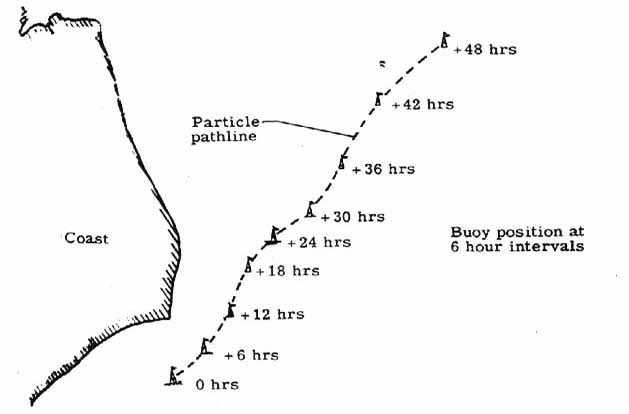
In
the Lagrangian approach to fluid flow, one particle is chosen and
is followed as it moves through space with time. The line traced
out by that one particle is called a particle pathline.
|
Joseph
Lagrange
Joseph Lagrange was an Italian-French mathematician who contributed
to the theory of numbers and to analytic and celestial mechanics.
He was born in Turin, Italy, in January 1736. His family was well
off but lost much of its wealth through unwise investments.
Lagrange largely taught himself mathematics, which he became interested
in after reading a memoir by the English astronomer Edmond Halley
(for whom Halley's comet is named) that discussed the use of algebra
in optics. He began teaching mathematics while still a teenager,
and helped found the Turin Academy of Sciences.
By the early 1760s, he was known as one of the greatest living
mathematicians. In 1764 he received a prize from the Paris Academy
of Sciences for an essay he wrote about the apparent oscillation
of the moon (called "libration") that makes its features
seem to appear and disappear.
In 1766, Leonhard Euler and Jean d'Alembert, other highly respected
mathematicians, recommended Lagrange for a post at Frederick the
Great's Berlin Academy. Lagrange stayed in Berlin until 1787. While
there he published a large number of papers on topics including
astronomy, the stability of the solar system, mechanics, dynamics,
fluid mechanics, probability, and the foundations of the calculus.
His paper "Réflexions sur la résolution algébrique
des équations" ("Reflections on the Algebraic Resolution
of Equations") was the first to consider the roots of an equation
as abstract quantities rather than as numerical values.
When Frederick died, Lagrange moved to Paris at the invitation
of Louis XVI, where he joined the Académie des Sciences in
Paris. There he managed to stay aloof from the political turmoil
that soon overwhelmed the country. While in Paris, he contributed
to the theory of fluid flow, introducing the Lagrangian function
important for aerodynamics, in his work Mécanique analytique.
This treatise synthesized the research that had been done in mechanics
since the theories of Sir Isaac Newton. Lagrange presented the law
of virtual work, and from that one principle, by the aid of the
calculus of variations, deduced both solid and fluid mechanics.
In 1790, Lagrange joined a committee working on establishing the
metric system and he advocated use of a decimal base. In 1797, he
became a professor of mathematics at the new École Polytechnique.
His lectures were published as the first textbooks on real analytic
functions. Although other academicians had been expelled or executed,
Lagrange was specifically exempted from the decree that all foreign-born
individuals leave France at the urging of the famous French chemist
Antoine Lavoisier (who himself was executed).
Lagrange was honored by Napoleon Bonaparte, who named him to the
Legion of Honour and a count of the empire in 1808. On April 3,
1813, he was named grand croix of the Ordre Impérial de
la Réunion. He died a week later.
|


 Home | About Us | Wright Brothers History | History of Flight | Sights & Sounds | Education | Sitemap