

|
|
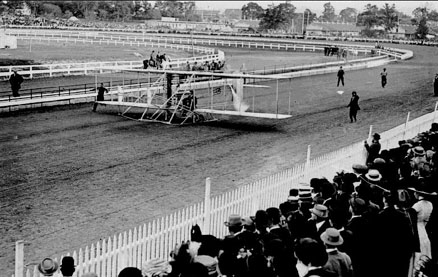
The Wright Fliers exhibition team in Milwaukee in 1910.
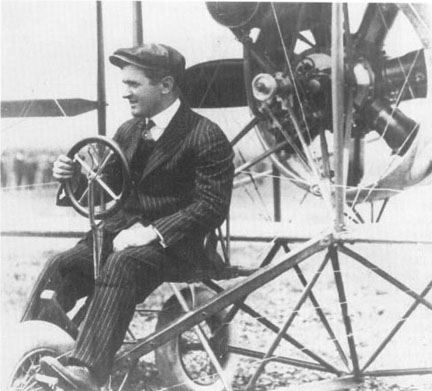
Lincoln Beachey always flew wearing a business suit. He flew over Niagara Falls on June 27, 1911.
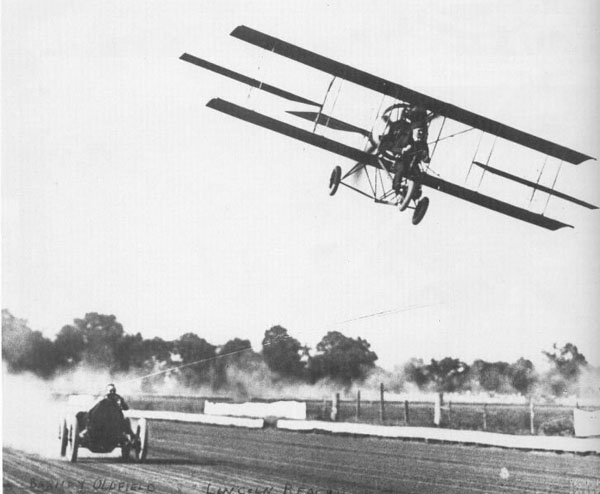
Early American stunt flyer Lincoln Beachey pits his airplane against a race car.
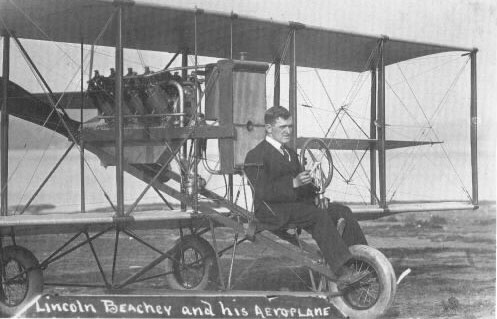
Lincoln Beachy and his airplane.
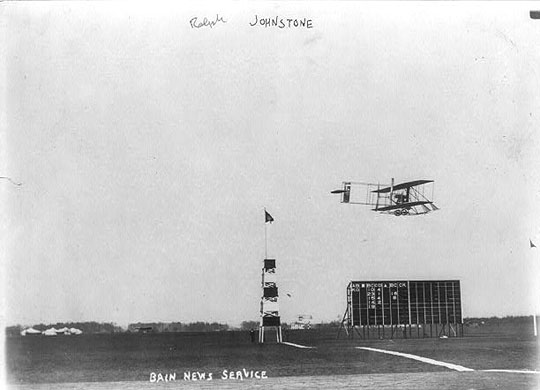
Ralph Johnstone crossing the finish line in an air race.
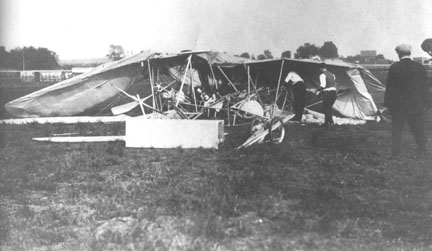
Ralph Johnstone crashes and dies in Denver, November 17, 1910. He was a member of the Wright Exhibition Flying Team.
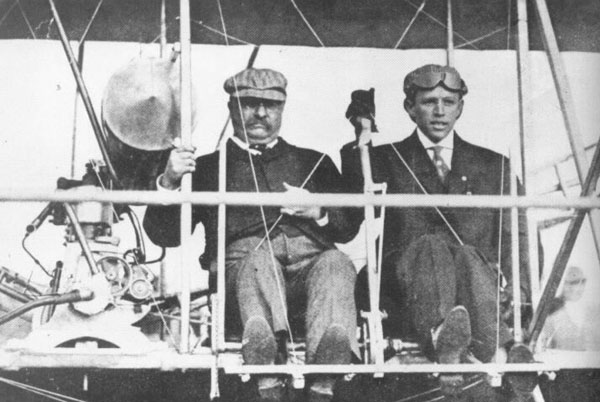
On October 11, 1910, Arch Hoxsey, a member of the Wright exhibition team, took President Theodore Roosevelt for his first airplane ride.
|
Early Exhibition Aviators
Soon after the Wright brothers’ first flight in December 1903, a great deal of debate arose about the best uses for "aeroplanes" (the spelling of the era). On one hand, some people wanted to develop aeroplanes for utilitarian purposes; others wanted to use them to entertain and to help spark the public’s interest in and enthusiasm about flight. Aeroplane builders like the Wright brothers and Glenn Curtiss, believing that the public was anxious to see aeroplanes first hand, fielded teams of exhibition fliers who traveled the country and demonstrated their aircrafts. Early exhibition aviators competed against each other to see who could perform the most daring aerial stunts. They also vied to see who could fly the fastest, farthest, and highest. They were courageous individuals who experimented with the limits of aeroplane design at a time when many designers were still struggling to solve some of the most fundamental aeronautical engineering problems. Although early exhibition aviators provided Americans with a great deal of entertainment during the pre-World War I era, they also suffered for their profession. True to their daredevil attitudes, many exhibition aviators pushed their aeroplanes past their limits and lost their lives. The Wright brothers formed an exhibition group in the spring of 1910. Reflecting their religious and social views, they forbid their group from flying on Sundays and from taking female passengers aloft. Needless to say, their team was all male. Arch Hoxsey and Ralph Johnstone were the stars of the Wright team. They often competed against each other at exhibitions. Audiences loved their antics and newspapers dubbed them the "Heavenly Twins." Despite their headlines, however, Hoxsey and Johnstone’s fame was not enough to save them from the fate of many exhibition pilots. In November 1910, Johnstone died when his aircraft’s wings failed while he was trying to perform a "spiral glide." Hoxsey died a month later on December 31 while trying to set an altitude record. Plagued by crashes and the death of several pilots, the Wright team disbanded in November 1911. Glenn Curtiss, the Wright brothers’ main rival, also started an exhibition team in 1910. A year earlier, the Wrights had filed a patent lawsuit against Curtiss over what they felt was an infringement on one of their aeroplane control systems. While the lawsuit would drag on for several years, it immediately affected the rivals’ exhibition teams; it intensified the competitive spirit between the two groups. Curtiss had become an American hero when he won the Gordon Bennett Cup race at the Reims Air Meet in 1909. Suddenly, several people wanted to take flight lessons from him, some of whom would go on to join his exhibition team. Blanche Stuart Scott was one of his first noteworthy students and the only woman to take lessons from him. In September 1910, she became the first woman to solo in an aeroplane. In October of that same year, she debuted with the Curtiss team. Scott would eventually retire from flying in 1916 when she grew distressed over the public’s morbid interest in the death of aviators. Charles "Daredevil" Hamilton was another of Curtiss’ well-known team members. Hamilton had begun as a parachute jumper and then moved on to piloting dirigibles. After studying briefly with Curtiss, Hamilton joined his exhibition team. Crowds loved watching Hamilton. He had a reputation for trying any stunt, anywhere, at anytime. Sometimes however, his bravado was not enough to keep him from crashing. During his career, Hamilton survived more than 60 accidents. Some, however, permanently scarred him. He reportedly had two replacement ribs made of silver, and metal plates in his head and shin. Ironically, Hamilton died of tuberculosis in 1914. Lincoln Beachey was the most accomplished and popular of all of the exhibition aviators. Like Scott and Hamilton, Beachey learned to fly with Curtiss and went on to join his team. Beachey was an extremely moody person who had a love-hate relationship with crowds: on one hand he hated interacting with fans, but on the other, he loved the adulation. As one of Beachey’s biographers noted: "He was all the stars of stage and screen combined, with a touch of Superman thrown in. From one end of the country to the other, he was known as The Man Who Owns the Sky." Beachey, who was an experienced dirigible pilot, apprenticed himself to Curtiss in 1910. Even though Beachey crashed during his first three flights, Curtiss continued to work with him. Fortunately for Curtiss, the gamble paid off. By the end of 1911, Beachey was aviation’s single greatest moneymaker. At the height of his career, Beachey would make more money in a single day than the national average annual income. Beachey’s career was littered with several key "firsts." He was the first to fly upside-down and the first American to "loop-the-loop." One of his more famous stunts was a daredevil flight over Niagara Falls and under the "Honeymoon Bridge." In Chicago, he flew alongside a train and rolled one of his wheels along the top of the entire train. But Beachey’s real specialty was his "Dip-of-Death," a stunt in which he would dive straight for the ground at full speed and then pull up at the last second. Many spectators grew overly excited watching him perform the feat, and some even fainted. Even Orville Wright, Curtiss’ bitter rival, was in awe of Beachey’s abilities and proclaimed: "An aeroplane in the hands of Lincoln Beachey is poetry. His mastery is a thing of beauty to watch. He is the most wonderful flyer of all." According to some scholars, Beachey entertained more than 17 million people in some 126 cities from November 1913 to November 1914. Eventually Beachey left the Curtiss team and embarked on a series of famous exhibition races with the era’s most popular automobile racer, Barney Oldfield. Beachey and Oldfield traded wins every other day to keep fans interested. In their first year of exhibiting together, Beachey and Oldfield raked in more than $250,000. Like many of his colleagues, Beachey died while exhibiting. In March 1915, Beachey was demonstrating a new monoplane at the Panama-Pacific International Exposition when the aircraft’s wings unexpectedly snapped off and he crashed into San Francisco Bay. Beachey, the era’s most popular aviator, died at the young age of 28. Another famous exhibition team was the Moisant International Aviators. John Moisant, an aeroplane racer who had gained notice for his victory at the Belmont Park Air Meet in New York, founded the group in the fall of 1910. His leadership, however, did not last long. On December 31, 1910, Moisant died while attempting to capture the Michelin nonstop distance prize; a sudden gust of wind had catapulted him out of his plane and he fell to his death. Notably, Moisant died on the same day as Arch Hoxsey. Although John’s death was a setback for the Moisant team, the group survived and went on to a successful exhibition tour of Mexico City in 1912, with John’s sister Matilde, and Harriet Quimby, as team members. Quimby and Matilde had coaxed John’s brother Alfred to teach them to fly, and in 1911, they became the first and second American women, respectively, to earn pilot’s licenses. Perhaps no other story better summarizes the varying degrees of dangers and luck involved in early exhibition flying than that of Harriet’s and Matilde’s final flights. By the spring of 1912, Matilde, bowing to pressures from her family, who were still upset about John’s death, determined that her last flight would be on April 14. While Matilde’s actual flight went according to plan, when she landed, her plane burst into flames due to a leaky gas tank. Even though Moisant’s clothes caught on fire, crewmembers were still able to pull her from the wreckage, and she escaped unscathed. Notably, Moisant’s ordeal took place only two days before Quimby’s record setting flight across the English Channel. Although Quimby’s Channel crossing would propel her to fame and make her a leading exhibition pilot, she would not be so lucky during her flight at the Third Annual Boston Aviation Meet a few months later. Like so many early exhibition pilots, Quimby crashed and died at an early age in front of thousands. Although early exhibition aviators entertained millions and helped spur popular interest in flight, some scholars estimate that the fatality rate among them was as high as 90 percent. For those early aviators who never became rich, famous, or even well known, that was an expensive price to pay. --David H. Onkst Sources and further reading: Corley-Smith, Peter. Barnstorming to Bush Flying: British Columbia’s Aviation Pioneers, 1910-1930. Victoria, B.C., Canada: SONO NIS Press, 1989. Corn, Joseph J. The Winged Gospel: America’s Romance with Aviation, 1900-1950. New York: Oxford University Press, 1983. Crouch, Tom D. The Bishop’s Boys: A Life of Wilbur and Orville Wright. New York: W.W. Norton, 1989. Deines, Ann. "Roy Knabenshue: From Dirigibles to NPS." Cultural Resource Management, 2 (2000): 20-21. Dwiggins, Don. The Air Devils: the Story of Balloonists, Barnstormers, and Stunt Pilots. Philadelphia: J.B. Lippincott Company, 1966. _____________. The Barnstormers: Flying Daredevils of the Roaring Twenties. New York: Grosset and Dunlap, 1968. Marrero, Frank. Lincoln Beachey: The Man Who Owned the Sky. San Francisco: Scottwall Associates, 1997. Moolman, Valerie. Women Aloft. Alexandria, Va.: Time-Life Books, 1981. O’Neil, Paul. Barnstormers and Speed Kings. Alexandria, Va.: Time-Life Books, 1981. Prendergast, Curtis. The First Aviators. Alexandria, Va.: Time-Life Books, 1980. Reinhardt, R., "Day of the Daredevil," American Heritage of Invention & Technology, Fall 1995, 10-21. Rich, Doris L. The Magnificent Moisants: Champions of Early Flight. Washington, D.C.: Smithsonian Institution Press, 1998. Tessendorf, K.C. Barnstormers and Daredevils. New York: Atheneum, 1988. "The Airplane Business." Museum of Pioneer Aviation. "Beachey, Lincoln -- 1966." National Aviation Hall of Fame. "Blanche Stuart Scott." National Air and Space Museum. Corley-Smith, Peter. "First in the Air in British Columbia." Royal British Columbia Museum. "Charles Hamilton." California State University at Dominguez Hills. Jones, Ernest. "1910 Proved Banner Year in the History of Early Birds." Early Birds of Aviation. "Katherine Stinson Otero, 1893-1977." Early Birds of Aviation. Lienhard, John H. "The First Daredevil." University of Houston, Engines of Our Ingenuity. ______________. "Katherine Stinson." University of Houston, Engines of Our Ingenuity. "Lincoln Beachey: A Brief Biography," Carroll Gray’s Lincoln Beachey website. "Matilde Mosiant." National Air and Space Museum. "Moisant’s International Aviators, Ltd, 1910." Early Birds of Aviation. "Pioneer Aviation -- Frequently Asked Questions." Carroll Gray’s Lincoln Beachey website. "The Pioneers The Wright Brothers." Wraga, William. "Curtiss, 1910-1920." Curtiss Wright Corporation. "Wright Brothers Collection, Biographical Sketch." Dayton and Montgomery County Public Library.
|
 Home | About Us | Wright Brothers History | History of Flight | Sights & Sounds | Education | Sitemap Home | About Us | Wright Brothers History | History of Flight | Sights & Sounds | Education | Sitemap |