

|
|
 The lines of the
Lockheed P-38 Lightning inspired Harley Earl, head of General Motors’
Art and Color section, to design the 1948 Cadillac.
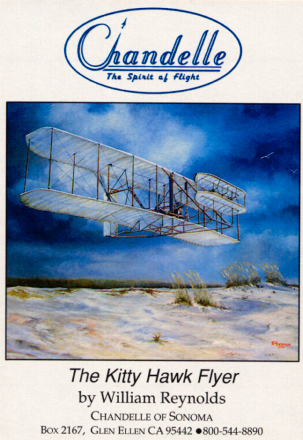 In 1986, a winery
in Sonoma, California began featuring a full-color aviation art
print on each bottle of its wine.
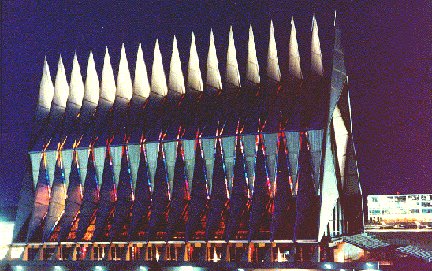 The U.S. Air Force
Academy Chapel, designed by architect Walter Netsch, is an example
of flight-inspired architecture.
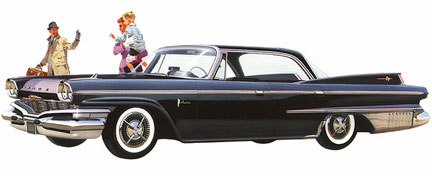 The 1960 Dodge Polara
four door hardtop reflected lines found in aircraft.
|
Flight-Inspired Design and ArchitectureTechnology has always been the underpinning of architectural innovation. Each new invention, from the arch to structural steel, allowed architects to create buildings that were bigger, taller, and stronger. In the 20th century, however, technology was not just the driver of engineering advances. It was also design inspiration. A new mode of transportation, the airplane, put every point on the globe within easy reach. Trips that used to take weeks now only took hours. The average person had become a citizen of the world, not just of a neighborhood or town. By the time humans ventured into space, Earth seemed like a much smaller place. The space age promised a greater, more exciting future where we could become citizens of the solar system and beyond. The enthusiasm for air and space travel has since been translated into a visual language of long, lean horizontal lines suggesting airplane wings, soaring upright structures and parabolic arches that direct the eye to the sky, and sharply contrasted angles that express speed. Art Deco, a mixture of styles in the 1920s and 1930s that celebrated technology and life in the modern world, was the first design trend to truly embrace the visual language of flight. The typical Deco building incorporated contrasting structural and decorative elements, such as colored, horizontal brickwork running perpendicular to a tall, narrow tower. The look was streamlined, suggesting speed in a non-specific way. The decorative arts were far more specific in how they used air motifs. Airplanes appeared in murals, metal work, and mosaics, as well as advertising and small household items. Even a simple object, like a cigarette lighter, could look sleek and sophisticated when hidden inside a small, chrome airplane. Zeppelins (also known as airships) were equally influential on Deco design. Their plump, rounded shape made an interesting contrast to the angular shapes of airplanes and the crisp lines that were so popular. Unfortunately, the zeppelin’s popularity came to an abrupt halt on May 6, 1937, when the LZ129 Hindenberg caught fire and crashed, killing 36 people. Flight-inspired design radically changed in the 1950s. The growing space race between the United States and the Soviet Union, combined with new technologies developed during World War II, shifted the concepts of "modern" and "futuristic" to space. Better yet, this space-age design was applied to affordable goods within the reach of most Americans. No matter what a person did for a living, one could look futuristic with the addition of a little space-inspired, forward-looking design. The boomerang, a shape that suggests speed and flight, adorned clothes, fabrics for furniture, advertisements, and decorative artwork on buildings. Lamps were topped with flying-saucer-shaped shades. Furniture, created by designers like Mies van der Rohe and Eero Saarinen, had large, chunky shapes perched on top of spindly legs with flat feet, making them look more like a lander resting on the Moon’s surface than a sofa sitting in a living room. Businesses adopted starburst and rocket logos, whether or not the imagery fit their product or service. Space-age design was a populist movement, everyone was welcome. Automobile designers took futuristic space design to the extreme, although the original inspiration that would transform the cars of the 1950s was an airplane. Harley Earl, the head of General Motors’ (GM’s) Art and Color section, saw the Lockheed P-38 Lightning and fell in love with it, taking its graceful shape to his drawing board. The first result, a 1948 Cadillac, had a rounded body, much like the Lockheed P-38’s three fuselages, and small tailfins. A couple of years later, all the competitors’ cars followed suit. Earl glimpsed another jet, the Douglas F-4D Skyray, and was once again returned to the drawing board. The Skyray was sleek and angular, with a sharp needle nose and spreading wings with parabolic air intakes. In a stunning combination of lowbrow taste and high-concept design, Earl reworked the design of several GM models using the lines found in the P-38 and Skyray until the automobiles truly resembled fighter jets, or Buck Rogers’ rocket ship. The bodies were longer, sleeker, and ended in dramatic, sweeping tailfins. The front end angled in from the tip of the hood to increase the cars’ fast look. The competitors again scrambled to turn out their own cutting-edge cars. The 1957 Mercedes-Benz 300SL had doors that opened up like a pair of wings, earning it the name "Gullwing." The Chrysler Corporation dubbed its futuristic look "The New Shape of Motion," while Plymouth called its the "Forward Look." Whatever the name, it transformed the common automobile into a high-tech transport (in style, at least). Architectural design also looked toward the skies for inspiration beginning with the 1950s. Advances in building materials, including reinforced cement, plastics, and steel, made it possible for architects to advance to the point where buildings became sculptures. World’s fairs and expositions, which had been showcases for new technologies and design trends since 1851, were a cornucopia of leading edge, innovative architecture. The Exposition Universelle et Internationale de Bruxelles (Expo ’58), held in Brussels, Belgium, offered Le Corbusier’s Philips Company Pavilion, with fan-like peaks (called "hyperbolic-parabloid" by Le Corbusier) made of individually-molded concrete slabs suspended together with support cables, and Guillaume Gillet’s French Pavilion, a double-winged frame with a long cantilevered arm over the entrance. The Civil Engineering Pavilion, designed by Van Doorselaere with Paduart (an engineer), also had a giant cantilevered arm and a soaring interior space. The theme of the Century 21 Exposition, held in Seattle, Washington, in 1962, was "Man’s Life in the Space Age." After visitors had marveled at John Glenn’s Friendship 7 capsule and a model of the Soviet Union’s Sputnik satellite, they could ride to the top of the Space Needle, the 600-foot (183-meter) observation tower and fair centerpiece designed by John Graham. The tower’s height, tapered middle, and needle antenna made it look as if the cylindrical observation platform was taking off, leaving behind a vapor trail of structural steel. However, neither this Exposition nor the 1964-1965 New York World’s Fair boasted a lasting impression on design. Fairs held outside the United States attracted a wider selection of well-known architects who could translate the spirit of the space age into dramatic buildings. By the end of the 20th century, world’s fairs and expositions had lost much of their popularity, but they still occasionally featured a marvel of space-age architecture. The 1992 Universal Exposition, held in Seville, Spain, had two bridges designed by Santiago Calatrava. The La Barqueta-Mapfe bridge consisted of a parabolic arch set against vertical structural cables, while the Alamillo bridge had a soaring, slightly-off-vertical upright support and diagonal tables that gave the impression that the bridge was flying over the water. Calatrava continues to take inspiration from flight. His redesign and expansion of the Milwaukee Museum of Art, completed in 2001, has a stunning, 90-foot (27-meter) high glass-walled reception area protected by wing-shaped sun screens that fly upward to open up the view. With its wings locked in the upright position, the museum addition perches on the edge of Lake Michigan like a giant mechanical bird. Wohlen High School, with its V-shaped roof, resembles a bird in flight, and many of his bridges use soaring arches like the one used in the La Bargueta-Mapfe bridge. Flight-inspired architecture met its perfect match in the Air Force Academy Chapel, designed by Walter Netsch for the Air Force Academy in Colorado Springs, Colorado. The exterior, which resembles a line of jets shooting toward the sky, perfectly expresses the goal of the campus, while the high, arched interior encourages religious expression. In fact, flight-inspired design is well suited for public cultural buildings in general, providing futuristic spaces for the arts, humanities, education, and religion. The visual language of flight can also transform everyday objects and experiences into something extraordinary, and will continue to decorate our daily lives as long as we seek out the unknown and strive to break the bonds of Earth. -Anne Simmons References and Further Reading Hine, Thomas. Populuxe. New York: Alfred A. Knopf, 1986. Kaplan, Wendy (ed.). Designing Modernity: The Arts of Reform and Persuasion, 1885-1945. New York: Thames and Hudson, Inc., 1995. Mattie, Erik. World’s Fairs. New York: Princeton Architectural Press, 1998. 1939 World’s Fair. A collection of images from the fair. 1950s Concept Cars. Circa 1950s. New York World’s Fair 1939-1940. Santiago Calatrava home page. Santiago Calatrava: the Unofficial Site. "Showcasing Technology at the 1964-1965 New York Word’s Fair."
|
 Home | About Us | Wright Brothers History | History of Flight | Sights & Sounds | Education | Sitemap Home | About Us | Wright Brothers History | History of Flight | Sights & Sounds | Education | Sitemap |