

|
|
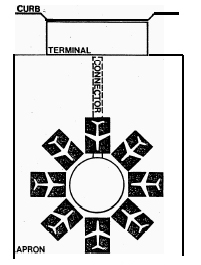 The satellite connector.
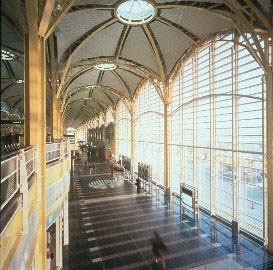 The renovated Reagan
National designed by renowned Architect Cesar Pelli, which opened
in 1997, added design details such as visible supports and transparent
walls to make it more attractive.
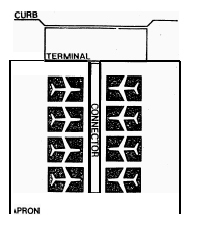 The pier connector.
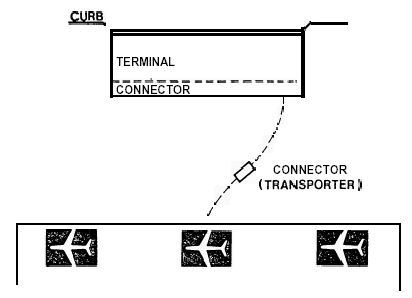 The transporter,
or "connector" design has planes parked on the tarmac with passengers
either walking out to them or transported by a bus or mobile lounge.
Planes can be arranged in various configurations.
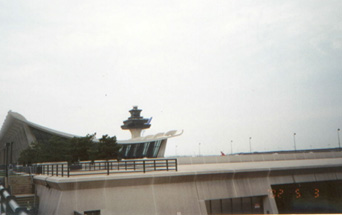 Control tower at
Dulles International Airport, 2002.
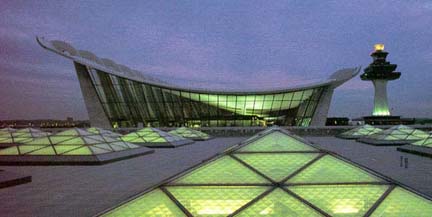 The signature architecture
at Washington, D.C.’s Dulles International Airport, designed by
Eero Saarinen, makes it one of the most recognized airport terminals
in the world.
|
Airport Design
People who travel by air spend many long hours in airports, and although after a while, one terminal begins to look much like another, several basic designs have evolved over time. These changes have been partly in response to the growing number of passengers and associated increased airplane size which, in its own right has helped draw more passengers to air travel. The earliest airports were really not airports at all. Rather, they provided a way for spectators to watch the air shows that became so popular early in the 20th century. The "aerodrome" consisted of a grassy area where planes could take off and land, hangars for servicing and storing planes, and observation stands. The field near Reims, France, where one of the earliest air meets took place in 1909, illustrates this type of facility. Some of these airfields also housed the earliest airplane factories. In Europe during World War I, military requirements led to the construction of airfields, but there were few provisions for passengers, since, for the most part, there were none. After the war ended, commercial airlines began to share the military airfields and either built new facilities for passengers and passport and customs control or converted existing hangars to those uses. At Le Bourget, near Paris, commercial aviation set up on one side of the airfield where the military had vacated. Le Bourget was both one of the earliest commercial airports and one of the first to have a building dedicated to commercial aviation, known later as a "terminal" but then as an "air station" or "airway station." This terminal and others in Europe and America resembled train stations, and hangars resembled train sheds. Airplane interiors also resembled Pullman rail cars. All of this was an effort to assure passengers that there was really nothing strange and new about traveling by air. One of the earliest airports was at Croyden, which opened in 1920 eleven miles from London at a site that had been used by the Royal Air Force and the National Aircraft Factory. Croyden served as the new "air port" of London, as well as the "customs port" of the country. Its two-story administration building, built in 1926-1928, was the largest terminal of its time. Croyden also had the first control tower, which the Air Ministry compared to the "bridge" on a battleship and the "traffic office" of a railway. In 1922 at Konigsburg, Germany built the first permanent airport and terminal especially for commercial aviation. This airport united airport functions in a single building, unlike Le Bourget, which had spread them among several buildings. The next year, Tempelhof airport was built in Berlin. Tempelhof, as well as other airports of the era, had a continuous paved surface, or "apron," in front of the terminal and lights, permitting night flying. Templehof’s terminal was curved, which although adopted because of a nearby cemetery fence rather than any functional reason, became a model for other airports. In the United States, two types of passenger terminals developed during the late 1920s. The "depot hangar," or "lean-to hangar," combined a waiting room, offices, and a hangar in a single building. Newark, New Jersey; Chicago; Wichita, Kansas; and Los Angles built terminals like this. "Simple terminals," like the one built by Pan American Airways in Miami, were buildings for passengers only. This period also saw the beginning of dedicated military airfields in the United States. In 1926, the Army Air Corps Act, among its provisions, specifically authorized the construction of a new airfield for training army pilots. A number of towns around the country vied for the chance to have this new field for their communities and made generous offers to the federal government that included free land, utilities, and other incentives. The site chosen north of San Antonio, Texas, eventually became Randolph Field. This field was very different from the usual military airfield plan, which usually was laid out like a frustum (a slice of a geometric cone that is next to the base). Rather, Randolph featured a circular system of roads, about 13 miles long, set in a larger square pattern with hangar lines and landing fields on two sides of the square. The field, which incorporated the most current urban planning concepts of the time, became known for providing the best pilot training available between the world wars and was also a model airfield for flight training (then called "flying training"). In 2001, the National Park Service and the U.S. "secretary of the interior" designated Randolph Field a National Historic Landmark. From 1928, American airports built paved takeoff and landing strips, which could support the new heavier planes. European airports began constructing these strips from the mid-1930s as its air traffic grew. About this time, too, airport designers, learning from their mistake of building airports with no room for growth, began constructing wedge-shaped buildings situated so that expansion could take place as air traffic grew. Airports, including Le Bourget and Tempelhof, built new terminals or expanded existing terminals in the 1930s to meet growing passenger traffic and the larger planes that needed more room for takeoffs and landings. Until World War II, Germany led the rest of Europe and the United States in building dedicated airports in its effort to join the post-World War I "modern world order." Tempelhof’s unusually large renovated terminal, begun under the direction of Adolf Hitler, became a symbol of Nazi expansion. Later, after World War II, it was used as the staging area for the 1948 Berlin Airlift. Gatwick Airport, completed in 1936 outside of London, was the first to build a satellite terminal where the planes were stationed around a circular "island" for servicing and boarding, and passengers used six telescoping passageways that moved on rails to go from the terminal to the planes. American coastal airports of the era could accommodate both landplanes, for domestic flights, and flying boats, for overseas flights. LaGuardia Airport in Queens, New York, (called North Beach when it opened in 1937) had both a marine terminal and a landplane terminal. The design of the marine terminal has been compared to the Pantheon in Rome, and the landplane terminal, built on two levels, adopted the best of train station design. In the United States, in contrast to Europe, the federal government was not responsible for airport construction. Although the U.S. Air Commerce Act of 1926 provided for federal promotion and regulation of airports, local authorities remained responsible for design and construction. The 1938 Civil Aeronautics Act provided some funds for American airport construction, but only as part of national defense, although federal aviation agencies issued guidance and regulations relating to airport design. The one exception to this rule was Washington National Airport, which opened in 1941, built with federal funds and owned by the federal government. Dulles Airport, which opened in 1962 outside of Washington, D.C., was also built with federal funds. Its landmark terminal was a compact, two-level structure designed to be expanded at either end and "topped off" with a distinctive glass-enclosed control tower that gave air traffic controllers an unobstructed view for many miles in all directions. After World War II, new airports were built in what was called a "connection" or transport design, with planes parked on the tarmac, and passengers walking out to them. As larger planes parked farther from the terminal, shuttle buses or mobile lounges began transporting the passengers to the planes. And as jets were introduced, which required even more space, this became even more essential. A feature of some airports of this era was the grouping of passenger buildings on an island in a central part of the airport with runways arranged in groups around the terminal. This arrangement allowed for expansion, and new gates and parking spaces for planes could be added to existing buildings. London’s Heathrow Airport and Paris’ Orly exhibit this arrangement. But additions also meant that passengers had to walk farther to reach their gate. "Pier finger" and star-shaped terminals appeared in the 1950s in the United States and soon after in Europe. Passengers would congregate in a central area and then move out into the fingers or points of the star to depart. Chicago’s O’Hare Airport and the airport in St. Louis used this design, as did Amsterdam’s Schiphol; Gatwick; and airports in Rome, Milan, and Copenhagen. Planes could load passengers directly from these fingers, and "moving sidewalks" often helped passengers reach their departure gate. Two levels separated arriving and departing passengers. This design evolved into decentralized satellites, or jetways—covered corridors that telescoped out from the main terminal to meet the plane, such as was built in Toronto in the early 1960s, which included nearby auto parking areas. (Gatwick near London had built an early satellite design in 1936.) The seven-story Terminal I at Paris’ Charles de Gaulle Airport, built in the late 1960s, was a separate, single round building with seven trapezoidal satellites, where the planes stood, and car parking in the middle. Another design was the "linear" or "gate arrival" terminal, a long but shallow corridor with appendages coming off it where the planes tied up and passengers boarded and deplaned. While this terminal design reduced the distance between airside and landside, the rise of terrorism in the 1970s increased airports’ safety and security requirements. Airports intentionally added "bottlenecks" to divide "secure" regions following passport inspection and searches from "open" areas where passengers bought tickets and checked their luggage. Arrival and departure areas, which had been as close to the airplanes as possible, became centrally located, resulting in longer walks for passengers (although many airports added moving sidewalks). In turn, airports added design details to make the airport more pleasant and attractive. Concourses, like in the terminals at Britain’s Stansted and Japan’s Kansai International airports, both built in the late 1980s and early 1990s, are large, open places with visible steel trusses or concrete ribs. Bright light filters in through transparent walls, and the roof (or ceiling from the inside) has become another facade. The expanded and renovated Ronald Reagan Washington National Airport and Denver’s new international airport, also illustrate this design. As the new century begins, and air travel has become ever more stressful, airport design teams have been attempting to use light and space to minimize the disruptions that travelers experience. Architect Koos Bosma calls it a "journey to the light." Though airports continue to use all the airport designs of the past century to some extent, designers strive to create modern environments emotionally and symbolically pleasing to the traveler while also meeting institutional requirements for safety and security. -Judy Rumerman References and further reading: Bednarek, Janet R. Daly. America’s Airports: Airfield Development, 1918-1947. College Station: Texas A&M University Press, 2001. Braun, Hans-Joachim. "The Airport as Symbol: Air Transport and Politics at Berlin-Tempelhof, 1923-1948," in Leary, William M., ed. From Airships to Airbus: The History of Civil and Commercial Aviation, Volume 1: Infrastructure and Environment. Washington, D.C.: Smithsonian Institution Press, 1992. Douglas, Deborah G. "Airports as Systems and Systems of Airports: Airports and Urban Development in America Before World War II," in Leary, William M., ed. From Airships to Airbus: The History of Civil and Commercial Aviation, Volume 1: Infrastructure and Environment. Washington, D.C.: Smithsonian Institution Press, 1992. Greif, Martin. The Airport Book: From Landing Field to Modern Terminal. New York: Mayflower Books, Inc., 1979. U.S. Department of Transportation, Federal Aviation Administration. "Planning and Design Guidelines for Airport Terminal Facilities." Advisory Circular 150/5360-13, April 22, 1988. Zukowsky, John. editor. Building for Air Travel; Architecture and Design for Commercial Aviation. Munich and New York: The Art Institute of Chicago and Prestel-Verlag, 1996. (Essays by Wolfgang Voigt, Koos Bosma, and David Brodherson).
|
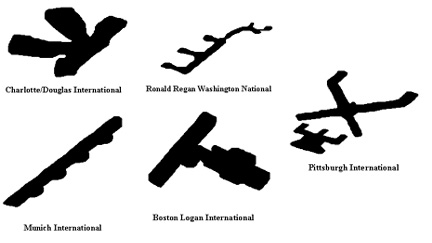 These diagrams show
airport terminal designs from several cities.
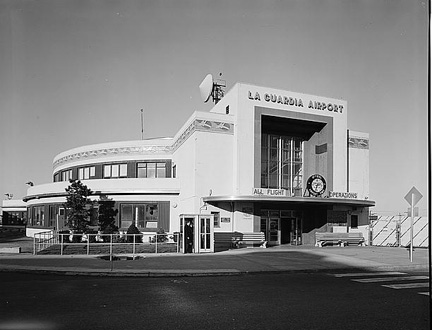 This photo shows
the Marine Air Terminal at New York Municipal Airport (La Guardia
Airport), Note the "flying fish" frieze along the top of the building,
in keeping with the nautical theme.
 Pan American Airways
Terminal Building, Miami, Florida, 1934.
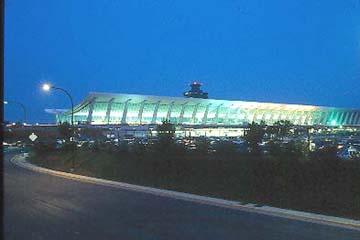 Dulles’ Terminal
Building was expanded to 1.1 million square feet in 1996.
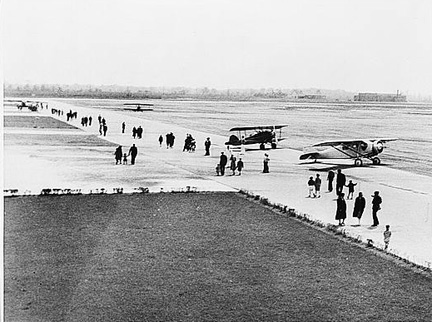 Air passengers in
the 1930s had to walk out to the planes to board, as this 1937 photo
of Cleveland Municipal Airport shows. After World War II, when planes
grew larger and had to park farther from the terminal, airports
began to use shuttle buses or mobile lounges to transport passengers
to planes.
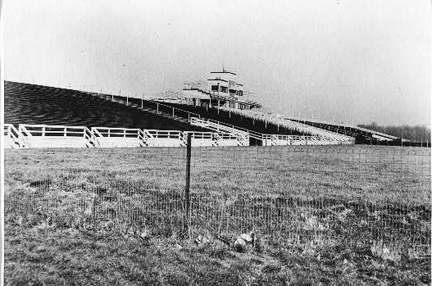 In 1937, airports
still had grandstands for viewing air races as seen in this photo
of Cleveland Municipal Airport. Cleveland frequently hosted the
National Air Races.
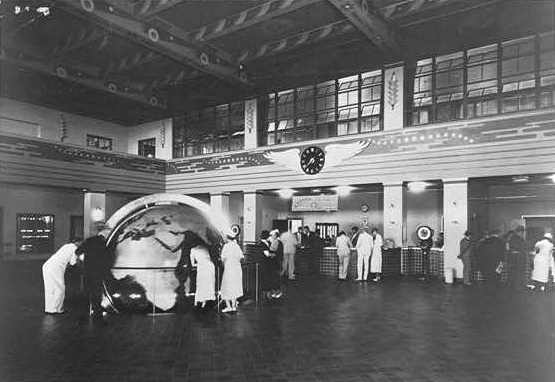
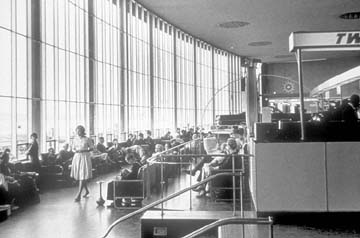 National Airport
passenger lobby shortly after airport opening in 1941. The airport
was built with federal funds.
|
 Home | About Us | Wright Brothers History | History of Flight | Sights & Sounds | Education | Sitemap Home | About Us | Wright Brothers History | History of Flight | Sights & Sounds | Education | Sitemap |