

|
|
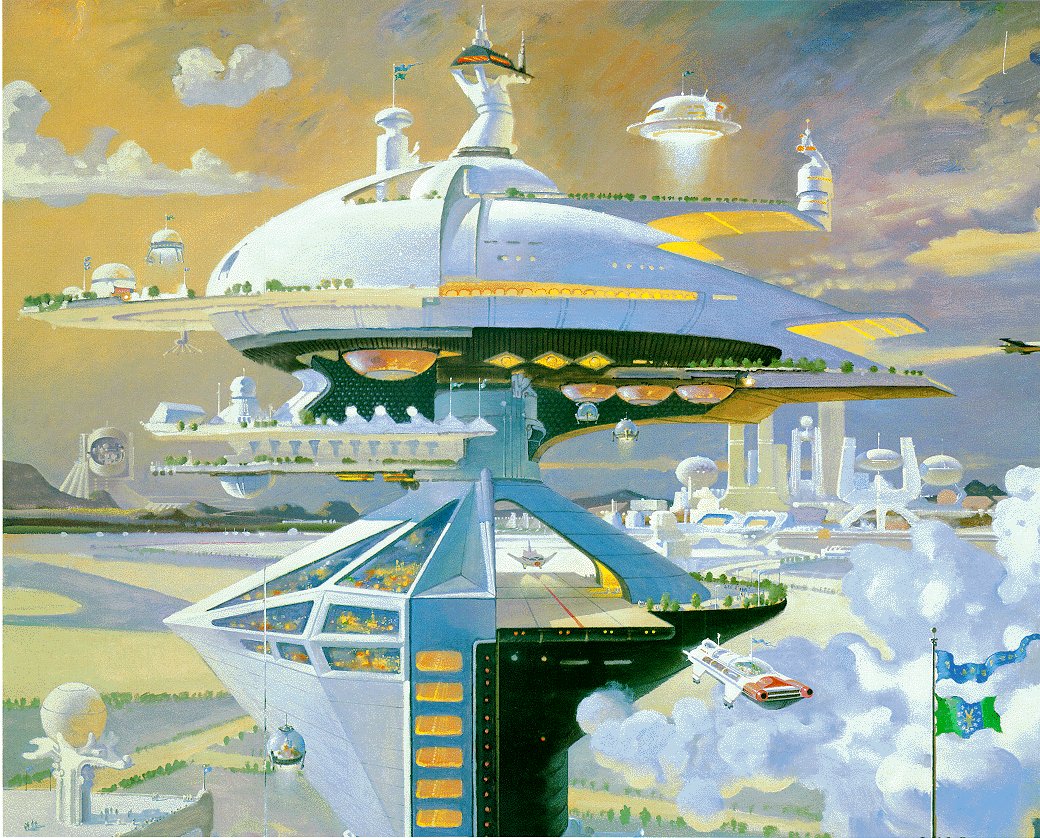 Megastructure of
the 21st Century by artist Robert McCall.
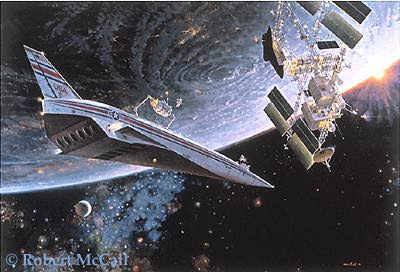 Artist Robert McCall’s
21st century scene features the X-30 National Aerospace Plane (NASP)
at a thriving space station.
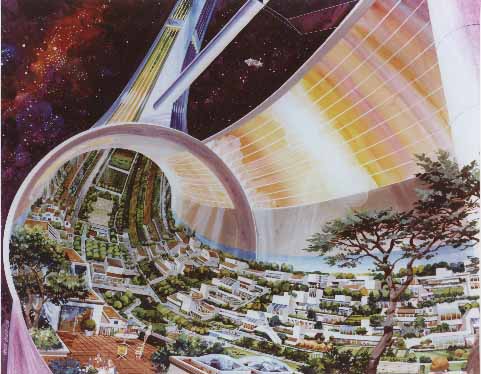 Cutaway view, exposing
the interior of a toroidal colony.
 This painting of
the interior of a Model III cylindrical Space Colonies by Don Davis
appears on the cover of "Space Colonies." NASA Ames Research Center
sponsors an annual space settlement design contest for 6-12th grade
students.
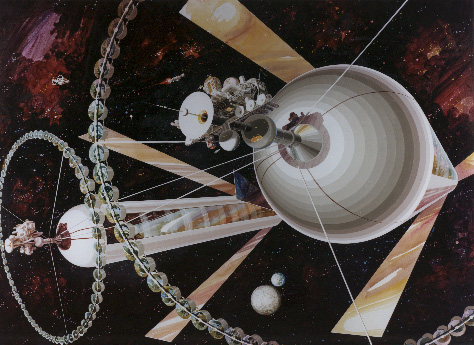 Exterior view of
a double cylinder colony.
|
Space as FrontierSpace has long been associated with imagery of the frontier. Captain Kirk’s famous opening monologue for the TV show Star Trek referred to "Space, the Final Frontier." President John F. Kennedy, who used rhetoric about a "New Frontier" of progress for America, and who was no space enthusiast, applied his frontier rhetoric to the Apollo program as a means of resolving a political crisis with the Soviet Union. Space activist groups and even national commissions on the future of spaceflight have also adopted this language and imagery. But this vision of space as a frontier has always been primarily an American vision rather than one held by other people around the world. Other countries and groups lack the cultural and historical traditions that portray a frontier as positive and challenging. Some even view a frontier as a barrier. What a frontier is and whether it is good or forbidding depends upon who you are and where you live. Furthermore, over the years, different people and groups have defined the space frontier in different ways, and even those who are enthusiastic about space exploration do not always view it as a frontier. Space has always held allure for many people and they have often adapted their existing worldviews to try to understand it. When astronomer Percival Lowell first postulated the existence of canals on Mars, newspaper and magazine writers soon speculated about exotic societies living on the Red Planet. Many illustrations of these societies were based upon romanticized notions of distant and exotic cultures on Earth, such as China, it was no coincidence that fictional space hero Flash Gordon’s nemesis was named Ming. Later, during the 1950s, popular media portrayals of space travel borrowed their ideas from Western movies. Space became a different version of the American West, with "moon men" replacing hostile Indians. Star Trek was sold to a TV network as "Wagon Train to the Stars." The Space Race of the 1950s and 1960s, in some ways tore down these popular images of space as a frontier. Photographs of the Moon and Mars sent back by spacecraft revealed their barren desolation and lack of even basic human necessities like air and water. In addition, early space exploration made it clear to many in the public that reaching this new frontier was difficult and would require billions of dollars of high technology. Unlike past frontiers like the American West and Alaska, which ordinary people could reach simply by selling their homes, buying a wagon and setting out, the only people who could explore the space frontier were those with military backgrounds or advanced educational degrees. Many people started to see space as a frontier only for astronauts from the National Aeronautics and Space Administration (NASA), not ordinary people. This view changed somewhat during the 1970s, due primarily to the efforts of a man named Gerard K. O’Neill. O’Neill was a physicist at Princeton University. In 1969, he began thinking about how structures in space could be built in the absence of gravity and determined that very large structures could be assembled. Whereas Konstantin Tsiolkovskiy and Wernher von Braun and others had long written about space stations, O’Neill was the first person to realistically propose massive space colonies. In September 1974, he published an article in the prestigious journal Physics Today on space colonies, proposing giant hollow cylinders that would rotate to create artificial gravity on their interiors. At this time others had proposed building giant solar power satellites that could beam their energy to the ground as a solution to the energy crisis and O’Neill proposed that his space colonies would be necessary to support them. These "O’Neill Colonies" captured the public imagination, for they would be populated by thousands of ordinary people, not superhuman astronauts. In July 1976, legendary science fiction author Isaac Asimov wrote about a space colony in the popular magazine National Geographic. In 1977, O’Neill published his influential book The High Frontier, which transmitted his ideas to a much broader audience. O’Neill even speculated that by the year 2150 more people could be living in space than on Earth. That same year, science writer Thomas Heppenheimer published his book Colonies in Space that also communicated a vision of ordinary people living and working in space. The idea was getting massive exposure. O’Neill’s vision led to the creation in 1975, of the L5 Society, named for a point in space, known as a Lagrangian Libration Point, where the colony would be situated. The L5 Society was a group of space enthusiasts and activists united by the vision of ordinary people living in space in a new frontier. It was in some ways a counterculture group of people who distrusted the government and what they called the "Establishment." But the L5 Society’s positive vision of space for everyone had one major obstacle to overcome, the immense cost of space travel. Initially these space enthusiasts believed NASA’s claims that the Space Shuttle would dramatically lower the costs of reaching orbit, and many early solar power satellite proposals used the shuttle as a baseline transportation system for their economic models. By the 1980s, excited by the possibility of space manufacturing, some people were even writing about space as "the next business frontier." But the Space Shuttle never met these expectations. The Challenger disaster also ended NASA’s "citizens in space" program and any near-term hopes of space enthusiasts that they would be able to travel into space themselves. People who continued to believe in space as a frontier turned their energies in new directions, including attempting to dramatically lower the cost of access to space and harnessing capitalist entrepreneurship to develop the resources needed for their vision. Many of the early efforts to reduce dramatically the cost of reaching space were led or inspired by people who had been disappointed that NASA had not helped further their dreams of accessing the space frontier. Some of these groups endorsed the idea of "space tourism" as a means of making space available to people other than those they viewed as NASA’s elitist astronauts. In the 1990s, space frontier imagery also emerged again in a different form. It was described in books like Kim Stanley Robinson’s fiction trilogy Red Mars, Blue Mars and Green Mars. But it was also promoted by a new activist group and its zealous leader. Robert Zubrin, a rocket engineer, argued that Mars was the next frontier and that failure to conquer it would condemn humankind to a life of misery. Zubrin and his followers also argued that the United States had been technologically and socially stagnant since roughly the 1950s, and claimed that the closing of the western frontier at the end of the 19th century had doomed the country. Their claims starkly illustrate the fact that most frontier imagery is positive and optimistic, often unrealistically so. Those who espouse this vision view the frontier as exciting, challenging, and full of resources that can help humanity. It is a distinctly romantic view based on an interpretation of the American western frontier that was popular during the early 20th century, and requires denigrating current society and idealizing the past. But as various writers have pointed out, the "West" was only a frontier to those who did not already live there. The native Americans who occupied the land simply thought of it as the place where they lived, and to them talk of "settling the frontier" was a euphemism for taking their land. The history of people referring to space as the next frontier starkly illustrates the fact that this imagery and language is not universal and depends upon the view of those who believe it and communicate it. Thus, just as people at the end of the 19th century looked at Mars and thought they saw a flourishing, exotic civilization, modern space enthusiasts and activists look at Mars and see a bold, challenging new frontier waiting to be explored, conquered and exploited. But not everyone agrees with this image; others look at Mars as a barren wasteland, or as a scientific wonder, and may fail to see anything that they would consider a frontier. A frontier does not exist as a physical thing, but rather as a vision in someone’s mind. - Dwayne Day Sources and further reading: Asimov, Isaac. "The Next Frontier?" National Geographic, July 1976, 76-89. Bainbridge, William Sims. The Spaceflight Revolution. Malabar, Fla.: Krieger, 1983. Bova, Ben. Welcome to Moonbase. New York: Ballantine Books, 1987. Gump, David P. Space Enterprise: Beyond NASA. New York: Praeger, 1990. Hartman, William K, Miller, Ron, and Lee, Pamela. Out of the Cradle: Exploring the Frontiers Beyond Earth. New York: Workman Publishing, 1984. Heppenheimer, T.A. Colonies in Space. Harrisburg, Pa.: Stackpole Books, 1997. Kraft, Christopher C., Jr. "The Solar Power Satellite Concept," Von Kármán Lecture, Fifteenth Annual Meeting of the American Institute of Aeronautics and Astronautics. July 1979. McCurdy, Howard E. Space and the American Imagination. Washington, D.C.: Smithsonian Institution Press, 1997. O’Leary, Brian, The Fertile Stars. New York: Everest House Publishers, 1981. O’Neill, Gerard K. The High Frontier: Human Colonies in Space. New York: William Morrow and Company, Inc., 1977. Pioneering the Space Frontier. The Report of the National Commission on Space. New York: Bantam Books, 1986. Robinson, Kim Stanley. Red Mars. New York: Bantam Books, 1993. Zubrin, Robert. The Case for Mars. New York: Simon & Schuster, 1997. The Mars Society. "Space Settlement Video Library."
|
 Home | About Us | Wright Brothers History | History of Flight | Sights & Sounds | Education | Sitemap Home | About Us | Wright Brothers History | History of Flight | Sights & Sounds | Education | Sitemap |