

| |
| |
| | 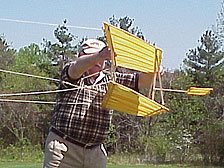 Tom Crouch readying his reproduction 1899 kite for flight | | Flying the kite, then and now... The Wright brothers kept no diary notes or records of the original kite's flights, and their accounts of its construction and flights come from depositions given in patent lawsuits in 1912. The descriptions of the kite's performance are brief. Although clear, the account is far from detailed. Orville recalled Wilbur's report that the kite "...responded promptly to the warping of the surfaces, always lifting the wing that had the larger angle [of incidence]. Several times, according to Wilbur's account to me, when he shifted the upper surface backward by the manipulation of the sticks attached to flying cords, the nose of the machine turned downward as was intended; but in diving downward it created a slack in the flying cords, so that he was not able to control it further. The model made such a rapid dive to the ground that the small boys present fell on their faces to avoid being hit, not having time to run...We felt that the model had demonstrated the efficiency of our system of control. After a little time we decided to experiment with a man-carrying machine embodying the principle of lateral control used in the kite model already flown"(McFarland, p. 11). Dr. Tom Crouch, senior curator of the National Air and Space Museum has written a definitive account of the Wrights' activities of this time, which can be read online at http://www.centennialofflight.net/history/1899_kite2.htm. He is also the owner of a reproduction 1899 kite, made for him by the Wright Experience. An experienced and respected kite flyer, his record in keeping the kite aloft is about a minute—a testament to Wilbur's description. Like all Wright machines, it worked as it was intended—but that doesn't mean it was easy to fly. | |
| |