

| |
| |
| | "In 1896 we read in the daily papers, or in some of the magazines, of the experiments of Otto Lilienthal, who was making some gliding flights from the top of a small hill in Germany. His death a few months later while making a glide off the hill increased our interest in the subject, and we began looking for books pertaining to flight." - Orville Wright, 1920 (McFarland, p. 3) 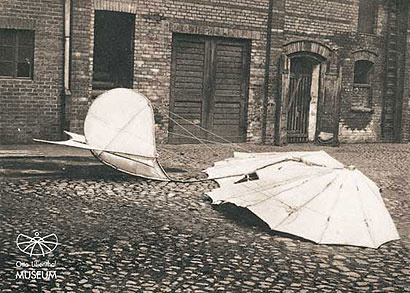 Otto Lilienthal's 1896 glider following his fatal crash Image credit: www.lilienthal-museum.de | |
| | ||
| | Otto Lilienthal was the pioneer most admired by the Wrights. He stood apart for the courage of his convictions and the thorough, rigorous quality of his scientific approach to flight. However, the Wrights only began to study his work when they learned of his death. Why did Lilienthal die? What caused his crash? How had his machine failed? What was wrong with his system of control? Lilienthal's death posed many questions to the Wrights, and helped clearly define their focus on what they saw as the most important single factor of flight: control. Lilienthal was their most significant source of inspiration and technical data for their first years of experiments. They based their 1901 glider on Lilienthal's lift tables, and used their groundbreaking wind tunnel experiments to test Lilienthal's lift table data. Eventually, the Wrights questioned almost every aspect of Lilienthal's work, as it formed the basis of their own early disappointing experiments. Like the other predecessors they admired, they never lost their respect for Lilienthal, despite having advanced far beyond his achievements. For more on the Wrights and Lilienthal, see In Depth: The 1901 Glider, and In Depth: The Wind Tunnel. | |