

| |
| |
| | 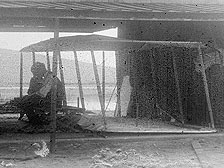 The 1901 Glider in its hangar, Kitty Hawk | | Making changes in the field The design of the 1901 machine sought to be an improvement of the 1900 glider, and was similarly based on the lift data compiled by Otto Lilienthal. In Wilbur's words: "Accordingly, the curvature of the surface was increased to 1 in 12, to conform to the shape on which Lilienthal's table was based, and to be on the safe side, we also decided to increase the area of the machine from 165 square feet to 308 square feet, although so large a machine had never been deemed controllable." In describing the machine's first trials, Wilbur relates their surprise: "The machine sailed off and made an undulating flight of a little more than 300 feet. To the onlookers this flight seemed very successful, but to the operator it was known that the full power of the rudder had been required to keep the machine from either running into the ground or rising so high as to lose all headway. In the 1900 machine one fourth as much rudder action had been sufficient to give much better control. It was apparent that something was radically wrong, though we were for some time unable to locate the trouble." When the brothers deduced that the movement of the center of pressure across the surface of the wings resulted in this imbalance and difficulty of control, a modification to the wing shape was required: "This point having been definitely settled, we proceeded to truss down the ribs of the whole machine, so as to reduce the depth of curvature... On resuming gliding, we found that the old conditions of the preceeding year had returned; and after a few trials, made a glide of 366 feet and soon after one of 389 feet." (McFarland, pp. 107-111) The Wright's clarity of purpose is well illustrated in the above passages. When faced with a puzzling and unforeseen problem with their design, they were able to isolate the source of difficulty and correct the problem. | |
| |