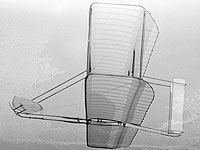
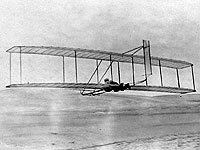
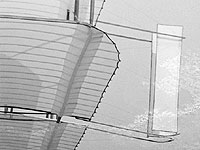
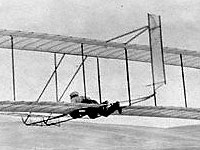
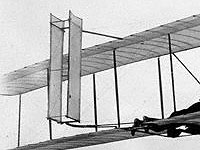
| Among the many changes from the 1901 glider was a vertical tail added at the rear of the 1902 glider. Its purpose was to correct a strange behavior of the 1901 glider: when the Wrights turned it to the left or right, it would start the turn, but then skid in the opposite direction!
The Wrights had accidentally discovered the third axis of control: yaw.
The rudder started as a double-vaned, fixed attachment. While it clearly helped in turning the machine, a new problem arose, which the Wrights called "well digging". In a turn, the glider would bank, with one wing higher and one lower. The problem was that it would then skid toward the lower wing.
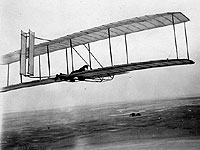
Orville deduced that making the rudder moveable would correct the problem. Wilbur took it further and attached it to the wing warping mechanism. A new single-vane, moveable rudder was attached. The solution worked, and the Wrights had the first fully controllable aircraft ever built.
The final change was to keep the rudder moveable, but return it to its double-vaned configuration. This provided more control, and with this machine, the Wrights completed over a thousand glides in preparation for the historic flights of 1903.
Image credits: Library of Congress |