

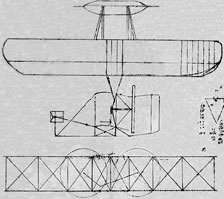
Preliminary drawing of the Flyer, 1903
Image credit: The Franklin Institute
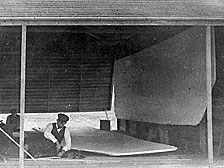
Orville assmebling the Flyer, Kitty Hawk
Image credit: Library of Congress
Designing the Flyer
On December 11, 1902, Wilbur Wright wrote to Octave Chanute:
"It is our intention next year to build a machine much larger and about twice as heavy as our present machine. With it we will work out problems relating to starting and handling heavy weight machines, and if we find it under satisfactory control in flight, we will proceed to mount a motor."
In fact, Wilbur had already written to the Daimler Manufacturing Company and several other engine companies in the previous weeks, seeking a motor built to the Wrights' specifications. The Flyer's design was already well under way.
The Wrights actually started discussing the Flyer's design even before they had left Kitty Hawk in 1902. They were confident in their wind tunnel data, their basic airframe design, their control system, and, perhaps most importantly, their ability as pilots.
By the following summer, the components for the Flyer were being completed for shipment to Kitty Hawk in the fall. In the seven months since Wilbur wrote to Chanute, the Wrights had completed the airframe, designed and built their first motor themselves, and developed the world's practical propeller theory. As Orville wrote to George Spratt, "Isn't it astonishing that all these secrets have been preserved for so many years just so we could discover them!!"
Other than one drawing made by Wilbur early in the Flyer's development, there are no existing plans for the flying machine. It can be assumed, that, just as they had done with their earlier gliders, they worked directly from their calculations, or from sketches made during the construction process of specific parts.