

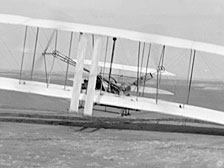
Orville during the third flight, December 17, 1903
Image credit: Library of Congress
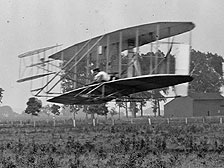
Orville piloting Flyer II, 1904
Image credit: Library of Congress
How well did the Flyer fly?
Although the Flyer was the first flying machine to actually make sucessful controlled, powered flights, and is perhaps the most significant airplane ever built, it simply didn't fly very well.
Although it had ample power, highly advanced propellers and an effective control system, the Flyer was a highly unstable craft. The Wrights realized almost immediately that the canard was too close to the center of gravity, resulting in a very sensitive pitch control. Indeed, all the flights the Flyer made ended when it abruptly nosed into the sand.
It is difficult to fully analyze the Flyer's capacity for flight from its four short flights. Perhaps the best proof of the Wrights' dissatisfaction with the design comes in the 1904 Flyer, which, when it was ready to test, was almost identical to the 1903 machine. However, by the time the Wrights had finished flight tests with it, they had modified it greatly, changing the position of the engine, fuel tank, and radiator in an effort to improve the machine's stability.
It wasn't until 1905 that the Wrights hit a successful design. The canard was greatly enlarged, and moved higher and further forward. The Flyer III was the world's first practical airplane, and was greatly changed from the 1903 design.