

|
|
|
|
|
|
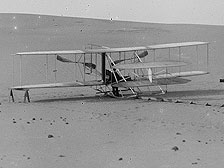
The Flyer III before flight, Kitty Hawk, 1908 |
|
Wilbur's accident in 1908... The Wrights returned to Kitty Hawk in the spring of 1908 with their Flyer III to practice before their public demonstrations later that year. The Flyer had been modified from the pilot-prone position to an upright sitting position with dual vertical controls. There were three control levers, all with a fore and aft motion. Moving the horizontal rudder control forward and back controlled the up and down movement of the elevator. Pushing forward made the aircraft dive, pulling back made the aircraft climb. The same motion was used on the center column, controlling the wing warping. Pushing forward rolled the aircraft left, and pulling back rolled the aircraft right. The rudder was controlled with a third lever. Over several days, both brothers made many successful flights, many of which were observed by newspaper reporters. On May 14th, Wilbur started out on a long flight. Out of sight of the camp, he became confused with the controls, and crashed the craft into the sand at full speed. Presumably, he pushed the elevator forward, diving the aircraft, instead of pushing the warping control forward, banking the airplane to the left. He was unhurt in the crash. It is not known how many Wright pilots had similar crashes because of this confusion with the controls. Although the brothers produced a set of controls for Wilbur's use which used a side-to-side motion for wing warping, they maintained the unusual foward-and-back control for wing warping in their future machines. |
|
|
|