 |
 |
 |
 |
 |
 |
 |
 |
 |
 |
 |
 |
 |
|


|
The Effect of Wind on Flight |
|
|
[Background and Procedure]
[Assessment] [Links]
[Books and Videos] [Home] |
|
|
Young children can feel the wind and see the effects of wind (or, moving air). The abstract notions that wind "is stuff" and has weight and pressure is too abstract for their developmental stage. However, they use their senses to begin to explore the action of the wind in nature and, subsequently, the effect of wind on flight.
Wind has a critical influence on flight not only because of the power of moving air but also because of shifts in air pressure that create lift. The Wright Brothers first flight was assisted by the high winds because they aimed their plane into the winds. However, such demonstrations and learning about the four forces of flight must be reserved for older children. At the early childhood level, children need to explore the existence and impact of wind on flying objects. Follow-up concepts for older children should include the four forces that allow for flight, changes in air pressure, and the impact on flight, and understanding of "pitch, roll, and yaw," that allow for directionality and control of flight. In the meanwhile, this series of activities provide several opportunities for exploration of wind and weather on flight and lay the foundation for further development of an understanding of the impact of weather on flight.
Procedure
[Objective A]
[Objective B] [Objective C]
Following are a series of activities that support the three main objectives of this lesson. With preschool children, the lesson will undoubtedly follow their lead, as evidenced through their conversations on the subject matter. Therefore, many more opportunities for activities abound; however, these, at least, provide a basic foundation for this lesson.
Objective A: brainstorm various objects that fly.
Introduce the children to the lesson by talking with them about transportation and types of transportation. How do they get to school? How do they visit their relatives that live out of town? Who has ever had to take an airplane to visit someone or go on a vacation?
Things to do:
Read a book such as Fortunately (Charlip) or Lisa's Airplane Trip (Gutman) that retells an adventure about flight.
Objective B: construct various objects that fly and test their capacity to fly under various weather conditions—specifically, wind.
Introduce the children to the concept that objects will not fly unless an action is taken. Show this by dropping an object such as a piece of paper or a leaf (germinating the concept of gravity as a force on an airplane). Why is it dropping? Why is it not flying? How can we make it fly? Record their responses.
Hopefully there is a wide variety of responses which relate to weather/wind ("you have to blow on it"), to the shape ("it has no wings"), or construction ("it doesn't have an engine"). Introduce weather as a factor which can impact upon the capability/accuracy/controllability of a flying object.
Things to do:
After the models have been made, fly them outside on a windless day. Ask the children what is being done to help the object fly. Emphasize the need for objects to be "pushed," like the wind is pushing the object (thus germinating the concept of thrust as a force on the airplane). Then, fly the objects on a windy day, or windy area, to observe what happens. (You can blow or use a fan if necessary to create wind). The children should draw/record and relate their experience.
Objective C: develop questions and ideas that will help us to explore what changes could be made to minimize the impact of wind on flying objects.
Recall the impact of wind on the various flying objects. Ask them if they have any questions about what happened during the activity. Ask the children if they think it would be safe to be in an airplane that is blown by the winds. Ask them about direction and what impact the wind made on the direction that the object was flying in when there was a big wind. What about flying in a storm?
Things to do:
|
|
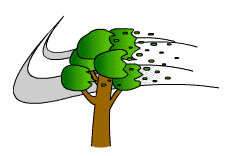 Wind is moving air. You cannot see air but it is all around us (see: Air is all around you, by Franklyn M. Branley, for a good "level one" introduction to this concept and some suggestions for demonstrating the existence and properties of air). Air is most clearly felt when the wind is blowing. Young children can observe wind in nature by watching the trees swaying in a breeze, the floating of leaves or dandelion seeds through the air, or the potentially devastating effects of a storm. Students can also see and feel the impact of wind, or moving air, by blowing on their hands, turning on a hair dryer, or using a fan.